
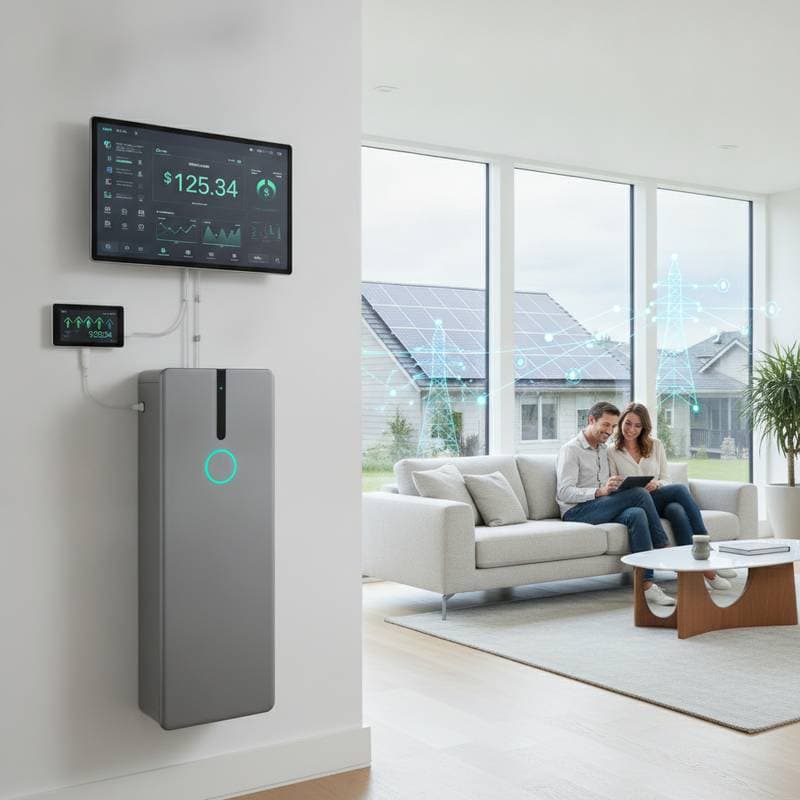
Turn Your Home Battery Into Steady Income Through VPPs
The U.S. residential energy storage market has surpassed 1.8 GW of installed capacity. Analysts expect that number to climb sharply as virtual power plant programs expand across multiple states. Virtual power plants, or VPPs, allow homeowners with solar plus storage systems to aggregate battery capacity and sell stored energy back to the grid. For many, this transforms a backup power system into a steady revenue source.
What a Virtual Power Plant Really Is
A virtual power plant is not a single physical site. It is a networked system that connects hundreds or thousands of distributed energy resources, such as home batteries, smart inverters, and controllable loads. Software platforms aggregate these resources to operate as one coordinated unit that can respond to grid demands. When peak demand hits, the VPP operator dispatches energy from participants' batteries, stabilizing the grid and helping utilities avoid costly peak generation.
The technology behind VPPs integrates advanced metering, predictive analytics, and automated dispatch management. Companies like Sunrun, Tesla, and sonnen have built proprietary platforms capable of controlling thousands of systems simultaneously. These digital controls allow precise timing and volume management for energy exports.
How Homeowners Earn Money
Participants in VPP programs earn compensation based on the value their battery provides to the grid. Payments may come through direct utility incentives, time-based energy credits, or market participation revenue. In some territories, homeowners are paid per kilowatt-hour delivered during dispatch events. Others receive annual capacity payments tied to the available power their systems can supply.
A 13.5 kWh residential battery paired with a 7 kW inverter could provide several hundred dollars in annual income when enrolled in a VPP. The exact figure depends on dispatch frequency, market pricing, and local grid conditions. Some homeowners report earnings that offset a significant portion of their monthly utility bill.
VPP income can also improve the overall economics of a home energy upgrade. When evaluating a system, homeowners should compare expected program payments with battery financing costs, utility savings, and available incentives. A reliable income stream may shorten the effective payback period, although no program should be treated as guaranteed investment income.
The Technology Behind Grid Coordination
At the technical level, VPPs rely on fast-responding control algorithms. These systems analyze real-time grid signals such as frequency deviations or voltage fluctuations, then issue commands to participating batteries within seconds. Each device communicates through a secure internet connection to the VPP operator cloud platform.
Smart inverters play a vital role. They enable bidirectional power flow and precise voltage regulation. Many inverters used in VPP programs comply with advanced grid-interactive standards.
For homeowners, the experience is usually automatic. A mobile application may show battery status, reserve settings, dispatch history, and earned payments. Strong internet service is important, and some systems include cellular communication as a backup. Homeowners should also confirm that software updates, cybersecurity protections, and customer support are included in the agreement.
Policy Support and Market Expansion
States including California, Massachusetts, and Vermont have been early adopters of VPP frameworks. Their regulatory commissions approved programs that compensate distributed resources for capacity and ancillary services. The success of these pilots has encouraged similar proposals in Texas, Arizona, and parts of the Midwest.
The U.S. Department of Energy Connected Communities initiative has funded demonstration projects exploring how aggregated residential batteries can provide load flexibility. Many of these programs operate in partnership with utilities such as Pacific Gas and Electric, Green Mountain Power, and Arizona Public Service.
Business Implications for Installers and Developers
For solar installers and energy service companies, VPP participation represents a new revenue channel. Battery deployment has often been constrained by high upfront costs, but VPP income opportunities improve the customer value proposition. Installers who can offer VPP-enrolled systems gain a competitive advantage.
EPC firms and developers are also evaluating aggregated commercial and industrial systems for future VPP networks. A 500 kW battery at a manufacturing facility can provide the same grid benefit as dozens of residential units.
Economics of Participation
While potential earnings are appealing, participants must consider technical and contractual factors. Most VPP agreements specify how often a battery can be dispatched and the minimum reserve it must maintain for home use. Frequent cycling could affect battery longevity.
System owners should also evaluate interconnection terms. Some utilities require specific metering configurations or communication gateways for participation. Financially, payback calculations depend on local energy rates and incentive structures.
Before enrolling, review whether the provider guarantees a minimum payment or uses variable compensation. Check for enrollment fees, early termination penalties, equipment warranties, and restrictions on changing battery settings. It is also wise to ask how the program handles outages. A well-designed VPP should preserve a practical emergency reserve, especially for homes that rely on batteries during storms or unreliable grid conditions.
Utility Perspectives and Grid Value
Utilities view VPPs as a flexible alternative to traditional grid expansion. Instead of investing in new peaker plants or transmission upgrades, they can contract distributed resources for capacity services. This model converts customer-owned assets into grid assets without physical construction.
Aggregated residential batteries could supply up to 20 GW of dispatchable capacity nationwide once participation rates exceed 10 percent of solar households. That level of distributed capacity would rival several large-scale generation facilities.
VPPs can also support cleaner neighborhoods by absorbing excess solar production and releasing electricity when demand rises. This reduces stress on local circuits and may help utilities integrate more renewable generation without relying solely on new infrastructure.