
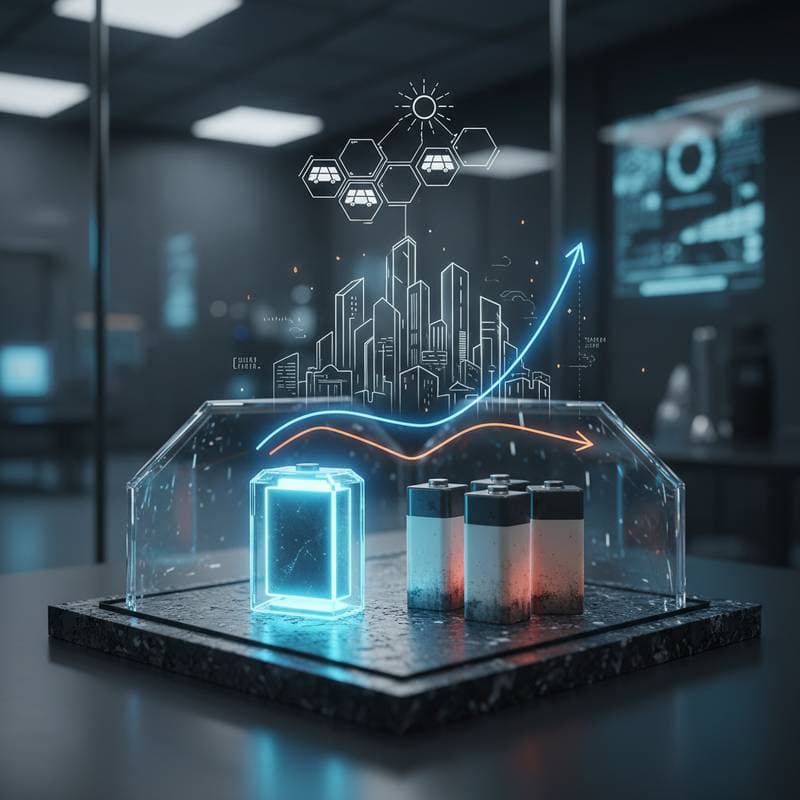
Why Solid-State Batteries Last Three Times Longer Than Lithium-Ion
Solid-state batteries represent a significant advancement in energy storage technology. These batteries transition from laboratory experiments to viable commercial products, challenging the dominance of lithium-ion batteries. Research and manufacturing efforts demonstrate that solid-state batteries offer superior longevity, enhanced safety, and increased energy density for both stationary and mobile uses.
Understanding Solid-State Battery Fundamentals
Solid-state batteries differ from traditional lithium-ion batteries by using a solid electrolyte instead of a liquid one. Liquid electrolytes in lithium-ion cells are flammable and susceptible to dendrite formation, which involves tiny metal filaments that can puncture separators and lead to short circuits. Solid electrolytes prevent dendrite growth and maintain stability under high-voltage conditions, allowing batteries to withstand more charge cycles before significant degradation occurs.
Early prototypes faced challenges with low ionic conductivity, but recent developments in sulfide, oxide, and polymer electrolytes have overcome this issue. These materials provide conductivity comparable to liquids while offering greater mechanical strength. Consequently, solid-state batteries achieve up to three times the cycle life of lithium-ion batteries. For example, a solar storage system or electric vehicle that typically requires replacement after eight years could operate reliably for over 20 years with solid-state technology.
Achieving Higher Energy Density
Beyond extended cycle life, solid-state batteries excel in energy density due to the use of lithium metal anodes. Lithium metal anodes store substantially more energy per unit weight compared to the graphite anodes in lithium-ion batteries. The solid electrolyte mitigates the fire risks associated with lithium metal, enabling engineers to create compact designs without compromising safety.
This advantage proves essential for applications where weight and space are critical, such as electric vehicles, drones, and off-grid solar installations. Prototype battery packs from leading manufacturers feature innovative form factors that eliminate the need for extensive cooling systems or reinforced containment. As a result, overall system weight decreases, and energy storage capacity increases within the same physical space, leading to more efficient and versatile power solutions.
Enhancing Safety and Operational Stability
One of the primary concerns with lithium-ion batteries is thermal runaway, where a single compromised cell can ignite a chain reaction affecting the entire battery pack. Solid-state batteries address this vulnerability through non-flammable inorganic electrolytes that preserve structural integrity even under physical damage, such as punctures. This inherent stability reduces the likelihood of fires and simplifies safety measures for deployment in vehicles and grid systems.
Automakers and energy grid operators recognize these benefits, which lower insurance premiums, streamline regulatory compliance, and prolong equipment lifespan. Recent industry shifts highlight safety as a core driver for investment in solid-state development. For instance, testing protocols now emphasize puncture resistance and high-temperature performance, confirming that solid-state batteries operate reliably in demanding real-world scenarios like extreme weather or heavy usage.
Overcoming Manufacturing Hurdles
Scalability remains the key challenge in bringing solid-state batteries to widespread adoption. Fabricating solid electrolytes demands precise control to ensure uniform quality and thin, defect-free layers, necessitating specialized equipment and processes. However, advancements in hybrid manufacturing techniques allow integration with existing lithium-ion production lines, accelerating progress.
Pilot facilities worldwide demonstrate feasible production rates, with costs expected to decline as economies of scale emerge. Researchers focus on optimizing material synthesis, such as improving sulfide electrolyte durability against moisture exposure. These efforts pave the way for solid-state batteries to not only compete with but surpass lithium-ion in high-demand sectors, including consumer electronics and renewable energy storage.
Securing Sustainable Energy Through Durability
The extended lifespan of solid-state batteries fundamentally alters the economics of renewable energy systems. With fewer replacements required, operators experience reduced waste generation, lower total ownership costs, and a more resilient supply chain. This durability supports the integration of solar farms, wind installations, and electric vehicle fleets by ensuring consistent power availability over extended periods.
Consider a large-scale solar array: traditional lithium-ion batteries might necessitate frequent module swaps, disrupting operations and increasing environmental impact. Solid-state alternatives minimize such interruptions, enhancing overall system efficiency and return on investment. Ultimately, this technology fosters greater energy security, making clean power sources more accessible and dependable for global infrastructure needs.